01
Test in Market
"In fast-moving markets, testing solutions in-market can be advantageous if you have development capacity to iterate quickly."
Product Design · Fintech · Lead Designer
Fidelity lost its loan verification partner, so I reframed enrollment as a read-back: show us your loan, we read it back instantly. The result: 60% more loans auto-verified and no 5-day wait for most participants.
Jump to the design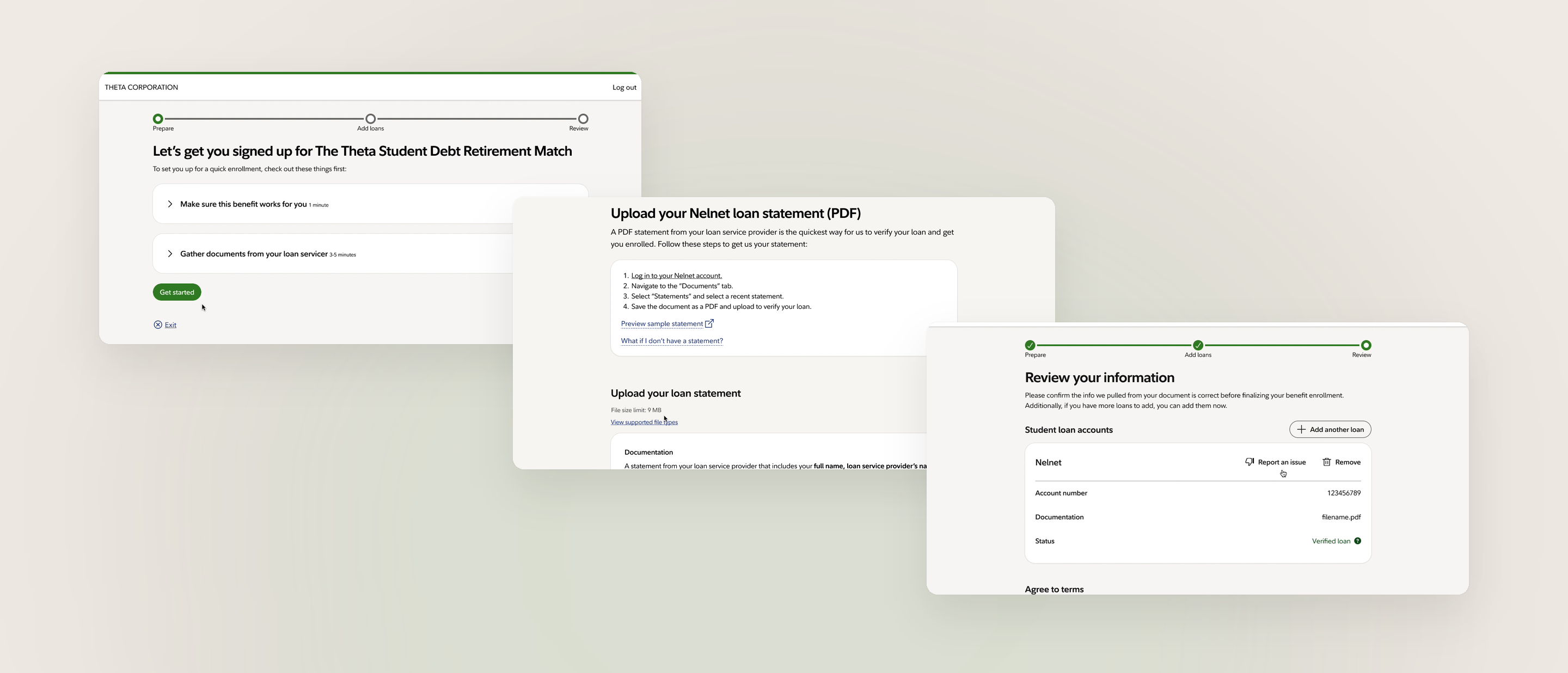
Fidelity lost its automated loan verification partner. Failed documents went to a 5-day manual review, and enrollees dropped off.
Reframed enrollment as a read-back: you show us your loan, we read it back instantly. Shipped in three phases: guidance, servicer selection, then the feedback loop.
More loans verified automatically, more people finishing enrollment, and the 5-day manual review gone for most.
01 · CONTEXT
Fidelity lost its automated loan verification partner due to legislative changes, disrupting the student debt benefit enrollment process. When uploaded documents failed verification, they were sent to a manual review team with a 5-day response time via chat.
As the market leader in student debt workplace benefits, Fidelity faced mounting pressure as enrollment rates dropped and operational costs threatened profitability. The business model — priced per enrolled participant — made every abandonment costly.
The original enrollment flow, before the redesign · select a screen to preview it
02 · HOW I FRAMED IT
Participants treated enrollment like mailing paperwork: upload something, then wait days to learn if it worked. That model hid every mistake until it was too late to fix. I reframed it as a conversation: you show us your loan, we read it back to you instantly, and you fix anything that's off before you leave. Guidance, servicer selection, and PDF extraction all serve that one idea. We ruled out adding more instructions up front, because users skipped text they couldn't act on yet.
I aligned partners on three goals (raise auto-verification, lift completion, cut drop-off) and a phased plan that shipped value every few weeks: guidance first, then servicer selection, then the feedback loop.
Pain points
Opportunities and insights
Pain points
Opportunities and insights
Pain points
Opportunities and insights
03 · KEY SOLUTIONS
Each moment shows what broke, what I tried, and what it changed.
Upfront Guidance
What was wrong
Our previous guidance page had large text blocks users likely skipped.
What shipped
Working with our enterprise patterns team, we designed an interactive component to encourage engagement with key information: benefit fit and document requirements.
+12%
automation increase within two weeks
What I triedFrom where we started to what shipped · select one to preview it
Servicer selection
What shipped
We moved guidance inline with the upload action. A loan servicer tile selector standardized the top five lenders covering 90% of loans, plus a type-ahead for others. Each servicer triggered lender-specific formatting instructions and account number guidance.
What changed
Two weeks post-launch, loan servicer name typos dropped to zero and account number failures fell by 60%.
+22%
additional automation increase (34% cumulative)
What I triedFrom where we started to what shipped · select one to preview it
When a document is missing information, how do we tell people and let them fix it?
What was wrong
Failed documents went to a manual review with a 5-day wait. People treated enrollment like mailing paperwork: submit, then wait. Many never came back.
What shipped
We read the PDF in real time, show what we found, and flag what’s missing while people are still in the flow. They choose to upload a better document or enter the detail.
5 days
of waiting removed
What I tried5 directions before this shipped · select one to preview it
The complete enrollment flow, across all three phases.
+30%
increase in enrollment success rates
What I triedFrom where we started to what shipped · select one to preview it
04 · OUTCOMES
Each release raised auto-verification on its own. Together they got 30% more people through enrollment and removed the 5-day manual review for most of them.
| Moment | Result |
|---|---|
| 01 Before you start | +12% |
| 02 Add your loan | +34% cumulative |
| 03 Fix it in the flow | +60% cumulative |
| 04 Enrollment confirmed | +30% enrollment |
“Appreciate that Fidelity is being intentional about enrolling the right fit participants, not just increasing enrollment numbers.”
05 · KEY LEARNINGS
01
"In fast-moving markets, testing solutions in-market can be advantageous if you have development capacity to iterate quickly."
02
"Ground work in specific goals over lengthy requirement documents. For every decision, ask if it will move the needle to meet your goal."
03
"Starting a project with technical restraints, even in a time crunch, can be limiting. Start with the best solution for the user, then scale back to what is achievable now."
Next project
Task Usage Predictor